













































「誰を外すか」ではなく「どの文脈で何を届けるか」——CEPを増やす実務へ
ここまで聞くと、ターゲティングはしないほうがいいのかと思うかもしれない。そこで、最後は木田氏がマーケターへの実務的な示唆へと引き取った。
木田:「問題は、ターゲティングを『市場から誰を捨てるか』を決めるために使ってしまっていることです。誰を市場から外すかではなく、どの文脈(CEP)で何を伝えるかを具体化するためのターゲティングであれば、問題ありません」
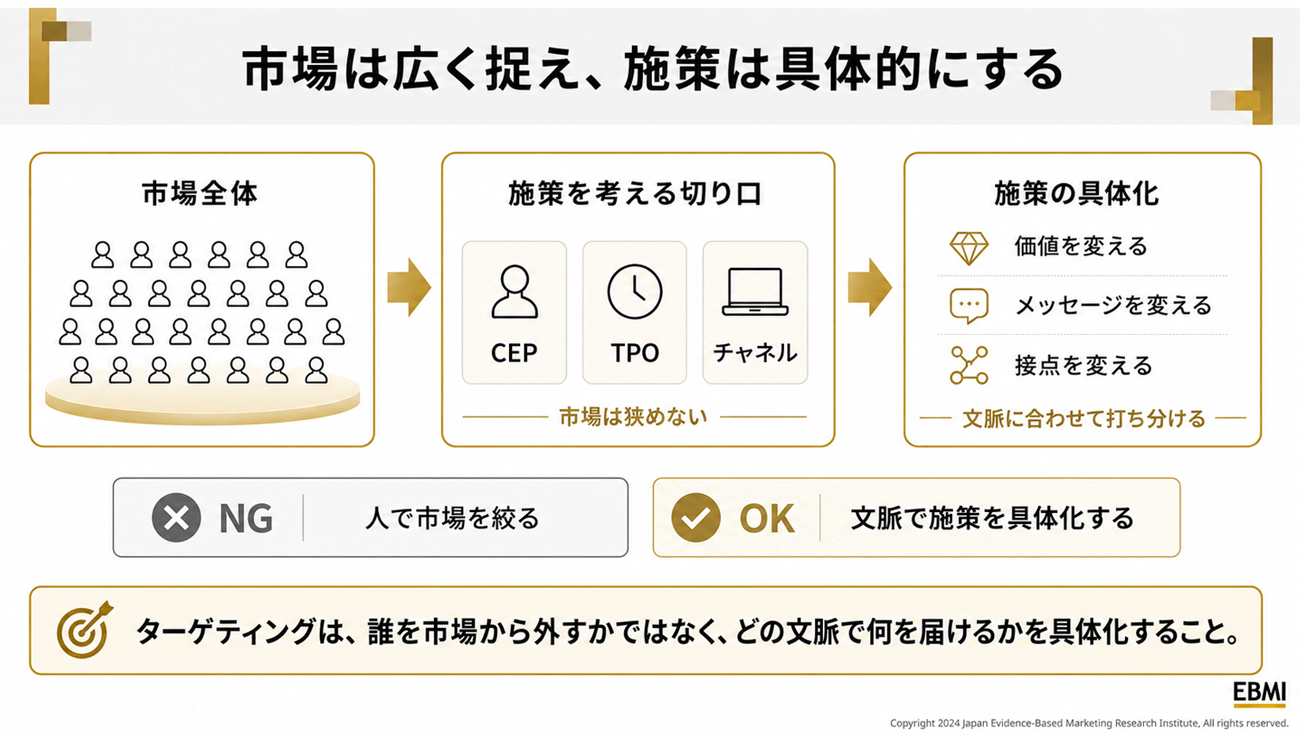
木田氏が示したのは、「市場は広く捉え、施策は具体的にする」というフレームだ。市場全体をまず広く捉えたうえで、CEP・TPO・チャネルという切り口で施策を考え、価値・メッセージ・接点を文脈に合わせて打ち分ける。人で市場を絞るのはNG、文脈で施策を具体化するのがOKという整理である。新規の商品開発であれば、初期段階で人物像を絞り込むこと自体は否定しない。ただし、そこから先マーケターが本当に考えるべきは、人物像を細かくすることではなく、需要の入口(CEP)を増やすことだ。
木田:「以前、電車内広告で、同じサービスのほぼ同じ訴求が複数面続いている広告を見たことがあります。私は、これは非常にもったいない広告の使い方だと感じました。たとえば同じサービスの広告でも、『休日に家でゆっくりしたい』『話題の作品を見たい』『移動時間を有効に使いたい』『家族で一緒に楽しみたい』というように、思い出す理由(CEP)を4つ用意し想起される入口を複数つくったほうが、同じ予算でも広告の役割を広げられます。広告費を増やす前に、まず需要の入口を増やすべきです」
最後に木田氏は、組織の問題にも言及した。正しい理論やエビデンスを示しても、意思決定は感覚でなされることがある。ゆえに、経験・直感・自社データ・外部エビデンスに共通の判断基準を持つ組織づくりが欠かせないという。
木田:「EBMを現場のマーケターだけが学んでも組織は変わりません。最終的に予算や戦略を決める意思決定層にも、最低限のマーケティングサイエンスの理解が必要です。我々もそこに対してちゃんと訴えていかなければいけない。もちろんエビデンスがすべてではなく、会社固有の事情や経営判断もある。経験や直感を否定する必要はありません。ただ、自社データと外部エビデンスを同じ土俵で議論できる共通の判断基準が必要です。EBMは、そのための共通言語として、少なくとも意思決定に関わる人には必要だと思っています」
「選択と集中」というマーケティングの常識は、狭い意味での効率を追い求めるあまり、市場そのものを狭めてしまう危うさをはらんでいる。ターゲティングをやめるのではなく、「どの文脈で何を届けるか」へ。エビデンスに基づいてその発想を転換できるかどうかが問われている。
【引用文献】
- Anesbury, Z., Winchester, M., & Kennedy, R. (2017). Brand user profiles seldom change and seldom differ. Marketing Letters, 28, 523–535.
- Clark, C. R., Doraszelski, U., & Draganska, M. (2009). The effect of advertising on brand awareness and perceived quality: An empirical investigation using panel data. Quantitative Marketing and Economics, 7(2), 207–236.
- D'Souza, G., & Rao, R. C. (1995). Can repeating an advertisement more frequently than the competition affect brand preference in a mature market? Journal of Marketing, 59(2), 32–42.
- Ehrenberg, A. S. C., Goodhardt, G. J., & Barwise, T. P. (1990). Double jeopardy revisited. Journal of Marketing, 54(3), 82–91.
- Ehrenberg, A. S. C., Uncles, M. D., & Goodhardt, G. J. (2004). Understanding brand performance measures: Using Dirichlet benchmarks. Journal of Business Research, 57(12), 1307–1325.
- Field, P. (2016). Selling creativity short: Creativity and effectiveness under threat. Institute of Practitioners in Advertising; Thinkbox.
- Kennedy, R., & Ehrenberg, A. S. C. (2001). There is no brand segmentation. Marketing Research, 13(1), 4–7.
- Novak, T. P., & MacEvoy, B. (1990). On comparing alternative segmentation schemes: The list of values (LOV) and values and life styles (VALS). Journal of Consumer Research, 17(1), 105–109.
- Reinartz, W. J., & Kumar, V. (2000). On the profitability of long-life customers in a noncontractual setting: An empirical investigation and implications for marketing. Journal of Marketing, 64(4), 17–35.
- Reinartz, W., & Kumar, V. (2002). The mismanagement of customer loyalty. Harvard Business Review, 80(7), 86–94.
- Romaniuk, J. (2023). Better brand health: Measures and metrics for a How Brands Grow world. Oxford University Press.
- Sandy, C. J., Gosling, S. D., & Durant, J. (2013). Predicting consumer behavior and media preferences: The comparative validity of personality traits and demographic variables. Psychology & Marketing, 30(11), 937–949.
- Sharp, B. (2010). How brands grow: What marketers don't know. Oxford University Press.
- Tanusondjaja, A., Greenacre, L., Banelis, M., Truong, O., & Andrews, T. (2015). International brands in emerging markets: The myths of segmentation. International Marketing Review, 32(6), 783–796.
- Terui, N., Ban, M., & Allenby, G. M. (2011). The effect of media advertising on brand consideration and choice. Marketing Science, 30(1), 74–91.
- Yankelovich, D., & Meer, D. (2006). Rediscovering market segmentation. Harvard Business Review, 84(2), 122–131.

